

Task Management
In short
Task Management is the work order engine in CAFMTEK. Reactive maintenance, corrective actions and service requests are tracked in one register with defined approval paths, SLA monitoring and a full audit trail. Each job carries a unique reference number and is tracked from creation to closure.
It turns scattered job requests into managed work.
In most facility teams before a system, jobs live in three places at once: a WhatsApp thread, a supervisor’s notebook and somebody’s memory. Task Management is the single register that replaces all three. Every piece of work, whatever kind and wherever it came from, is a record with a status.
One register, three kinds of work
- Reactive maintenance: Something broke and was reported.
- Corrective actions: Follow-up work from an inspection or an audit.
- Service requests: Non-fault work raised by a tenant or occupant.
They are handled by the same engine rather than by three separate processes, which is what makes reporting across them possible.
What each job carries
- A unique reference number: The number a requester can quote and a client can trace.
- Status tracking from creation to closure: Where the job is now, not just whether it is open.
- Defined approval paths: Who has to agree before work proceeds.
- SLA monitoring: Time against the target set by the contract.
- Integrated service history: The job joins the asset’s record when it closes.
- A complete audit trail: Who did what, and when.
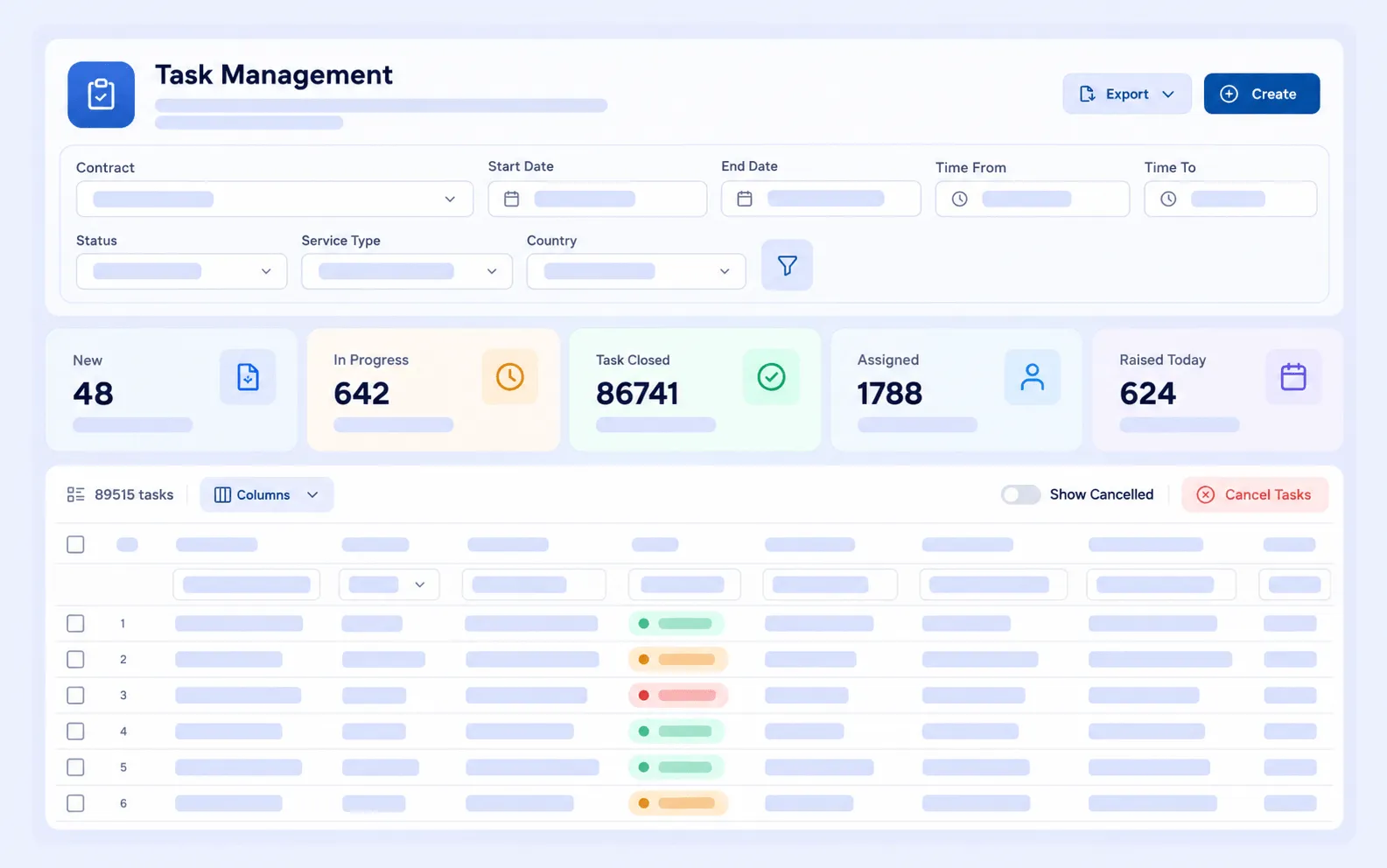
Task assignment and progress tracking, showing what is open, what is in progress and what has been closed.
How it connects to other modules
- Helpdesk and Self Services feed requests in.
- PPM Management generates planned jobs into the same register.
- Asset Management receives the completed job into the asset’s history.
- SLA & KPI Management measures each job against its contract target.
- Fault detection and diagnostics creates work orders automatically from sensor alarms.
Frequently asked questions
Does every job get a reference number?
Yes. Each job carries a unique reference from creation.
Are planned and reactive jobs in the same place?
Yes. Reactive maintenance, corrective actions, service requests and PPM jobs are all tracked in one register.
Can approvals be required before work starts?
Yes. Approval paths are defined and applied to the jobs that need them.
What happens to a job after it closes?
It joins the service history of the asset it was raised against, which is also what the suggested PPM intervals are calculated from.