

CAFM software stands for Computer-Aided Facility Management software. It is the system that holds your asset list, your floor plans, incoming job requests and your maintenance schedule in one place. Facility teams use it to plan work, assign it, record what was done and report on it.
Most facility teams do not start out looking for CAFM software. They start out with a problem: nobody can say when the chiller was last serviced, the job requests arrive by WhatsApp and get lost, and the monthly report takes two days to build from spreadsheets.
CAFM is the category of software built to fix that.
What does CAFM stand for?
Computer-Aided Facility Management. The name is old, and it describes the idea rather than the product: using software to manage a facility, instead of paper and spreadsheets.
CAFM software puts the information a facility team relies on into one system, so the asset list, the job history and the maintenance plan all refer to the same records.
What does CAFM software actually do?
Five things, in most systems.
Asset register. Every asset you maintain, with its location, make, model, serial number and full service history. This is the part everything else depends on. A work order is attached to an asset. A PPM schedule is attached to an asset. If the register is wrong, everything built on it is wrong.
Work orders. A request comes in, from a tenant, a helpdesk or a supervisor. It gets assigned to someone with the right skill, completed on site, and closed with a record of what was done.
Planned maintenance. PPM schedules generate jobs automatically, either on a calendar or on a meter reading such as running hours, so routine work does not depend on someone remembering.
Space management. Floor plans, who occupies what, and how much of it is actually used. This is the part a maintenance-only system does not have.
Reporting. SLA performance, maintenance history, cost by building, space utilisation. For teams working under a contract, this is often the reason they bought the system in the first place.
What problem does it actually solve?
Most teams replace three things with a CAFM system: spreadsheets holding the asset list, a WhatsApp group carrying job requests, and someone’s memory holding the maintenance schedule.
Each works until it doesn’t. The spreadsheet goes stale because updating it is nobody’s job. The WhatsApp group loses jobs when a supervisor is off. The memory leaves when the person leaves.
The value of a CAFM system is less about any single feature and more about having one record that survives people changing jobs.
What are the benefits of CAFM software?
Work stops getting lost. Every request goes into one queue and every job has a status. That alone removes a large share of the complaints a facility team receives.
Planned maintenance actually happens. Jobs generate on schedule rather than when someone notices. Over time, that usually means fewer breakdowns, though how much fewer depends entirely on how well the schedules were set up.
Reporting takes minutes, not days. The data is already in the system, so the monthly report is a query rather than a rebuild.
Compliance records are findable. Inspections, certificates and their expiry dates sit against the asset. When an auditor or client asks for evidence, you can produce it. Compliance with safety and regulatory standards is a critical part of facility management.
Space decisions are based on data. Utilisation figures replace opinions about which floors are busy.
Everyone works from the same information. Supervisors, technicians, the helpdesk and the client see the same job, instead of four versions of it.
Further Reading: 10 Benefits of Using CAFM Software for Smart FM
Who uses CAFM software?
- Facility management companies. Managing buildings for clients, under contracts with SLAs to prove. Reporting per client and per building matters as much as the maintenance itself.
- Property and asset owners. Multiple buildings, each with its own maintenance and cost picture.
- Corporate real estate teams. Offices, warehouses and sites where both space and equipment need managing.
- Hospitals and healthcare facilities. Critical equipment, strict compliance records, and no tolerance for missed inspections.
- Schools, colleges and universities. Varied spaces, from classrooms to labs to sports facilities, with heavy seasonal maintenance.
- Manufacturing and industrial sites. Complex layouts and equipment where downtime stops production.
What these have in common is not size. It is that someone has to answer for the condition of the building, and needs a record to answer with.
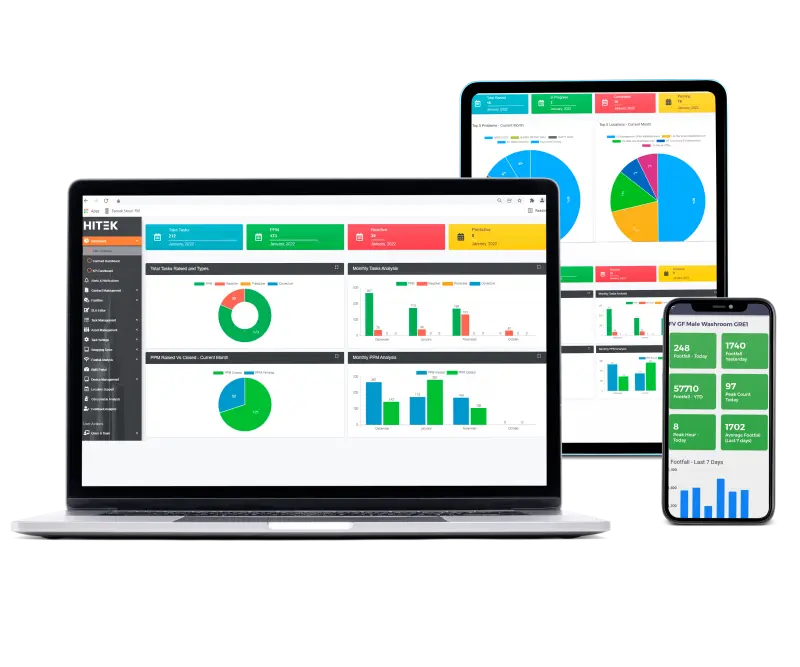
Introducing CAFMTEK, a Computer-Aided Facility Management (CAFM) software solution that revolutionizes facility management. It helps streamline operations, optimize resources, and gain control over assets and locations.
- Key features include IoT integration, WhatsApp AI chatbot, cloud and mobility technology, and a customer-oriented FM app.
- CAFMTEK offers unique features such as mobility work order creation, and SLA-based zones.
- The software aims to improve operational efficiency through connected workforce features, IoT platform integration, and mobile app connectivity.
How is CAFM different from CMMS and IWMS?
The three overlap and are often confused.
| Covers | Best when | |
|---|---|---|
| CMMS | Maintenance only: PPM, work orders, spare parts, equipment history | Your job is keeping equipment running |
| CAFM | The whole facility: assets, space, work orders, contracts, reporting | You manage buildings, not only equipment |
| IWMS | The property portfolio: everything in CAFM plus leases, projects and sustainability reporting | You manage property as well as facilities |
Wider is not better. It is only better if you have those problems. Our full comparison of CAFM vs CMMS goes into the differences in detail.
What should you look for when choosing CAFM software?
Four things decide whether a system works in practice.
Does the technician app work on site? Including in a basement plant room with no signal. If job updates are hard on a phone, they will not happen, and the data stops being reliable within weeks.
Does the reporting match what you are asked for? Build your actual client report during the trial, not a demo report.
Will it connect to what you already run? A building management system, an ERP, an access control system. Ask exactly how the connection is built and who builds it.
What does implementation involve? The asset register, the PPM schedules, the training. This is where CAFM projects succeed or fail, and it is rarely in the sales conversation.
Two guides go deeper: how to choose CAFM software in the UAE covers what to check and what to ask vendors, and what to prepare before a CAFM go live covers the data and preparation work that decides whether the rollout sticks.
Common questions
Is CAFM software only for large facilities?
No, but the value depends on what you are responsible for. A single building with no space planning and a small maintenance scope may be served well by a maintenance-only system. The moment you have to prove SLA performance to a client or a landlord, spreadsheets stop being enough.
Is CAFM software cloud based?
Most modern systems are, which is what allows technicians to use a phone on site. Some vendors still offer on-premise installation for organisations with data residency requirements. Ask, rather than assume.
Do we need to replace our building management system?
No. A BMS controls equipment such as HVAC, lighting and pumps in real time. CAFM manages the work around that equipment. They do different jobs and are often connected, so a BMS fault can raise a work order automatically.
How long does it take to get running?
That depends almost entirely on your asset data rather than the software. Teams with a clean asset register move quickly. Teams starting from scattered spreadsheets spend most of the project getting the data right, which is time well spent.