

Quick answer
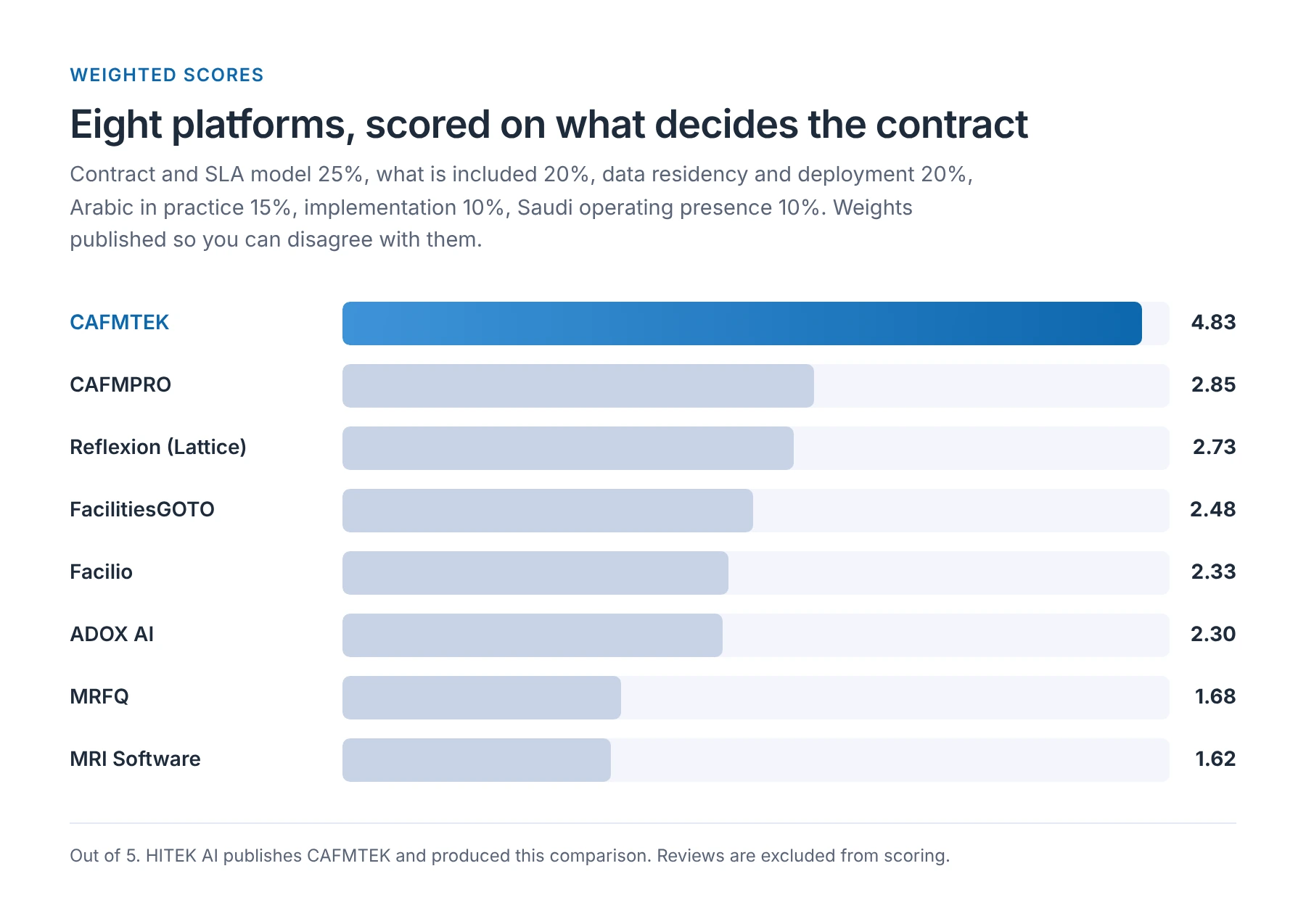
On the weighting below, CAFMTEK scores highest at 4.83 out of 5, driven by the service level model and by what sits inside the base price. CAFMPRO is second at 2.85 and is the only vendor here publishing a price. Reflexion by Lattice is third at 2.73. Four of the eight do not publish how a job is measured. Six do not publish where Saudi client data is held.
Three things decide a CAFM contract in the Kingdom, and none of them is whether the vendor has an office down the road.
Whether you can prove where the time went when a client disputes a service level. What the system costs in year two, once the things you assumed were included turn out to be add-ons. And whether your technicians actually use it, which in practice means whether the Arabic is real or a set of translated labels sitting on a layout built the other way round.
There is a fourth that is not a preference at all. If data residency is written into your tender, a vendor who cannot name a country is out before the demo.
So we read eight vendors’ websites to see which of them answer those questions before you sign, rather than after.
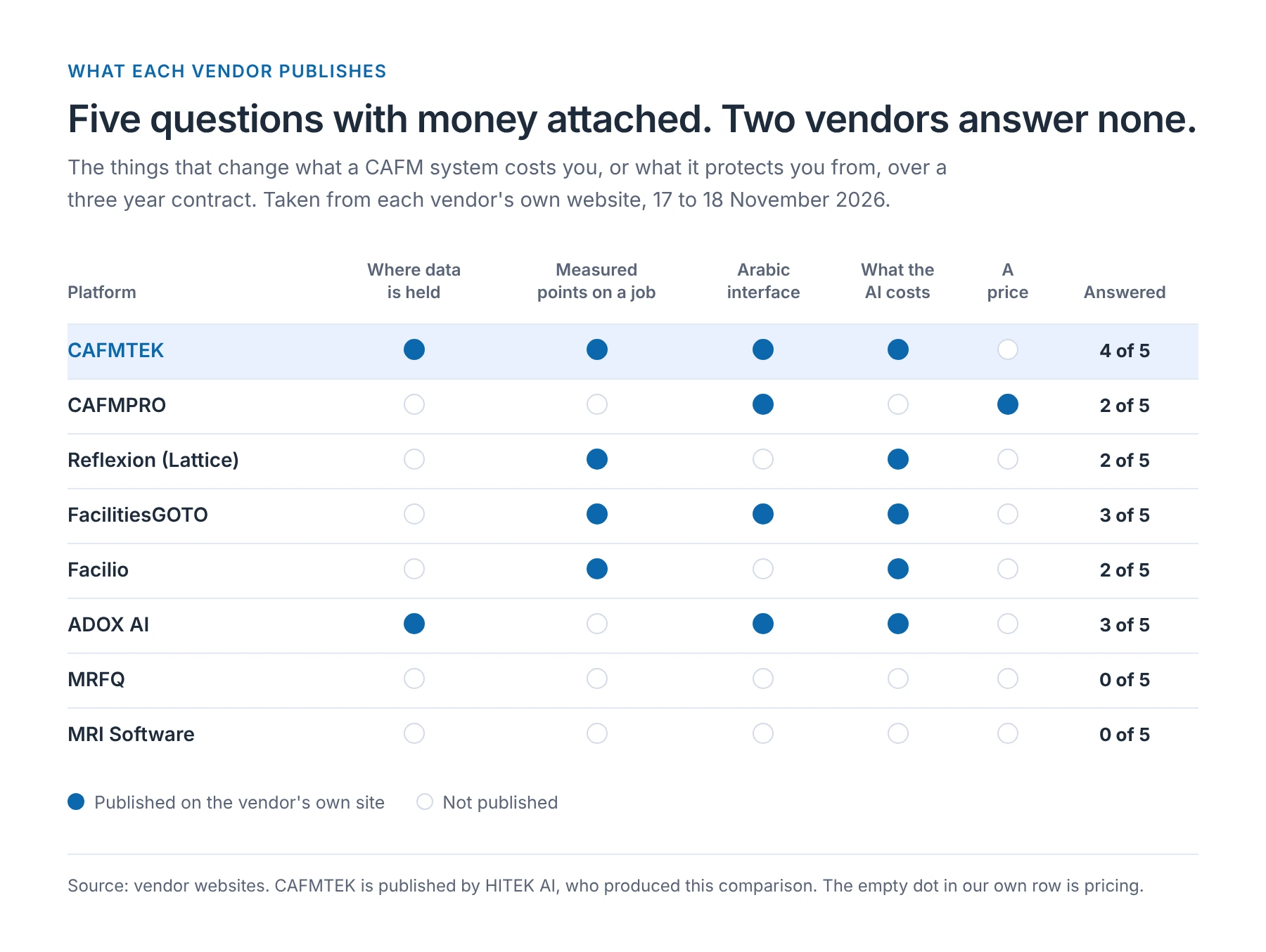
Who wrote this, and why that matters. HITEK AI publishes CAFMTEK, which is one of the eight and the one that scores highest. Read it with that in mind. What we offer instead of neutrality is evidence: every competitor claim comes from that vendor’s own site, with the link and the date, and the section on where CAFMTEK loses is a real section. We also publish what we left out and why.
Who this is for
FM providers and in-house teams running maintenance contracts inside Saudi Arabia, with service level obligations you have to evidence to a client every month.
It assumes you already have three or four names on a shortlist and need to separate them on something other than a feature list, because every feature list in this market says roughly the same thing.
Who this is not for
Single building, no client to report to, wanting cheap work order tracking. Pick something simple and skip this.
Standardising across a dozen countries rather than operating well in one. The criteria below are the wrong criteria for that job.
Space planning and lease administration as the main event. That is IWMS, not CAFM, and most of this will mislead you.
How we evaluated
| Criterion | Weight | Why it carries that weight |
|---|---|---|
| Contract and SLA model | 25% | Decides whether you can defend your performance at a monthly review. Penalties and renewals hang on it |
| What is included | 20% | Decides your year two cost, which is usually different from your year one cost |
| Data residency and deployment | 20% | A tender gate. If your contract requires it and the vendor cannot answer, nothing else matters |
| Arabic in practice | 15% | An adoption risk. If the people doing the work cannot use it, you have bought shelfware |
| Implementation | 10% | Mobilisation slips are expensive and are usually caused by data, not software |
| Saudi operating presence | 10% | Useful when something goes badly wrong. Not a reason to choose a system |
On that last row. An earlier version of this comparison weighted local presence at 25%, the heaviest weight on the page. That was wrong. Nobody buys facilities software because the vendor has an office nearby, any more than you pick an ERP that way. A local entity helps during a difficult mobilisation and is sometimes required by a tender, and that is what 10% reflects. Changing it moved our own score up by 0.05 and moved MRI Software down by 0.33, so you should weigh that knowing who made the change.
Review volume is excluded entirely. It measures how long a vendor has been selling, not how well the product fits a Saudi contract.
What this method cannot see. It reads published material. It cannot tell you how a vendor behaves in month eight, whether their implementation team is any good, or what they will concede in a negotiation. A vendor who publishes little may still be excellent. They have just made it harder for you to find out.
Can you prove where the time went?
This is the row that costs the most money and the one buyers check last.
Most systems record two things: when you responded and when you closed. Two timestamps are enough for a client to tell you that you missed a target. They are not enough for you to explain why.
Picture the review. A four hour target, the job took eleven. On a two point system you and your client are looking at the same two numbers and arguing about everything in between. On a four point system the record shows that nobody reached site for six hours because access was refused, and that the risk was contained forty minutes after that while a part shipped. Same eleven hours. Completely different conversation, and in most contracts a completely different penalty.
| Platform | Workflow steps published | Measured points against a contract target |
|---|---|---|
| CAFMTEK | Not at step level | Four: respond, attend, contain, fix |
| Reflexion (Lattice) | Not at step level | Three: assignment, response, resolution |
| Facilio | Not at step level | Two: response, resolution |
| FacilitiesGOTO | Not at step level | One: response targets |
| CAFMPRO | Six, corrective and again for PPM | Not published |
| ADOX AI | “from request to sign-off” | Not published |
| MRI Software | Not published | Not published |
| MRFQ | Not published | Not published |
CAFMPRO is the case worth slowing down for, because it is the one most likely to be misread. They publish the most detailed workflow documentation here: six stages for corrective work, six for planned, plus something nobody else bothers with. Approved hold time and downtime are recorded against the work order, with the approver and the reason captured, and the clock pauses during the hold. If you have ever lost an argument about a delay your client caused, you know exactly what that is worth.
A documented workflow and a measurable service level are different things. Only one of them survives a monthly review.
What is not published is any measurement model underneath that workflow. No statuses, no timestamps, no targets per contract, no targets per priority, no operating hours. Counting their six stages against our four points would be the easy comparison to make and the wrong one, which is why this table has two columns.
The second question in this row matters nearly as much. If you run a hospital on 24 hour cover and an office tower on Sunday to Thursday, eight to five, those cannot sit on one clock. Ask whether targets are set per contract, whether each priority inside a contract carries its own target and its own operating hours, and who is able to change a target after a job has closed. A target anyone can edit afterwards is not evidence of anything.
What does it cost in year two?
Year one is the number in the proposal. Year two is the number after you have discovered what is an add-on.
| Platform | How it is packaged | Published price |
|---|---|---|
| CAFMTEK | Sixteen modules, one edition. Fault detection, predictive maintenance and suggested intervals included | Not published |
| CAFMPRO | Fifteen modules, priced by module, with a five module core bundle | SAR 10,000 a year excluding VAT, five modules, up to five users |
| ADOX AI | Three tiers. Predictive maintenance, IoT, energy and ESG, IWMS and API are Enterprise only. On premise and BMS integration are top tier. Entry tier caps at 1,000 assets and five admin users | Tier names only, all “Custom” |
| Reflexion (Lattice) | Thirteen modules labelled add-on, including performance rating, permit to work, audits and HSE reporting | Not published |
| FacilitiesGOTO | AI line items in the upper two tiers only | Not published |
| Facilio | One subscription for AI agents, credits based on usage, no per-user licences | Not published |
| MRI Software | Not published | Not published |
| MRFQ | Not published | Pricing page exists, carries no figures |
Two things in that table are worth your attention.
The first is where AI sits. ADOX leads with AI on every page it publishes, and puts predictive maintenance in its middle tier. FacilitiesGOTO confines AI line items to its upper two tiers. Lattice labels thirteen modules as add-ons, among them performance rating, which is the module you would use to score a subcontractor. None of that is hidden. It is in their own pricing tables. It just is not in the demo.
The second is that only one vendor here publishes a number at all, and it is not us. CAFMPRO starts at SAR 10,000 a year for five modules and up to five users. That is a floor rather than a system price, since their modules are priced individually, but it is more than the rest of us give you.
The question that cuts through all of it: send me the module list with the word included or add-on printed beside every line, and tell me what the price does at renewal and when I add sites.
Will your team actually use it?
This is the row that gets treated as a courtesy and is actually an adoption risk. A system your helpdesk staff and technicians avoid becomes a system somebody retypes into a spreadsheet, and then you are paying for both.
The distinction that matters is not whether a vendor says Arabic. It is whether the interface mirrors or only the labels change. A translated system still runs left to right: the menus, the table column order, the asset tree, the printed job card. A mirrored system flips all of it.
| Platform | What is actually claimed |
|---|---|
| CAFMTEK | Whole interface mirrors right to left, including menus, tables, forms and the asset tree |
| ADOX AI | “native Arabic interface, including complete RTL (right-to-left) layout” |
| FacilitiesGOTO | Both apps in Arabic among twelve languages, plus reports in English and Arabic |
| CAFMPRO | Every page has an Arabic equivalent, switching with one click. Right to left layout not explicitly claimed |
| MRFQ | Arabic-first, claimed in an article rather than on the product pages |
| Facilio | Arabic for the AI voice helpdesk only. Core interface not published |
| Reflexion (Lattice) | Arabic-speaking implementation and support. No Arabic interface claimed |
| MRI Software | Not published. The Saudi site is in Arabic, which is not the same thing |
Test it rather than ask about it. During the demo, switch the system into Arabic, then open a work order list, a form with several fields, and the asset tree. Then print a job card. Printed output is where half-finished Arabic support shows itself, because it is the part nobody remembers to mirror.
Can they name a country?
Not a philosophical question. A procurement one. If residency language sits in your tender and a vendor answers with a region rather than a country, they have failed a condition rather than lost a point.
| Platform | Where Saudi client data is held |
|---|---|
| CAFMTEK | Servers HITEK AI owns inside Saudi Arabia. On premise also available |
| ADOX AI | “secure local Saudi cloud infrastructure (AWS Riyadh, Azure KSA)” |
| CAFMPRO | Not published. Agreed per client during their Discover and Prepare steps. On premises on request |
| Reflexion (Lattice) | Not published, and they decline to claim it. On premise keeps data on servers you choose |
| MRI Software | Not published, including on their own Saudi site |
| FacilitiesGOTO | Not published. Public cloud, private cloud on the top tier |
| Facilio | Not published. Cloud only |
| MRFQ | Not published |
Two of the eight put data in the Kingdom, and they are not the same arrangement. ADOX rents capacity in a hyperscaler’s Riyadh region. CAFMTEK runs machines it owns. Both answer where the data sits. Only the second also answers who administers it and from which country, which is a separate clause in a lot of tenders. Ask which one you are being offered.
Lattice comes out of this better than the blank cell suggests. Rather than a reassuring phrase, their page tells buyers to get the country and the data centre named in writing before signing. That is better advice than some vendors who do publish a location, and it is the advice we would give too.
Three separate answers are worth asking for, because they can be three different countries: where the database sits, where the backups sit, and which country it is administered from.
Does a local office matter?
Some, and less than vendors want you to think.
It helps when a mobilisation goes badly and somebody needs to be in the building. It helps when a tender requires a local entity to contract with. It does not make the software better, and nobody shortlists an ERP or a finance system on the basis of a nearby office.
It has also stopped separating anybody. Four of the eight publish a Riyadh street address now: CAFMTEK in Al Olaya, CAFMPRO in Al Duraihemiyah, MRI in Al Ghadeer and FacilitiesGOTO in Al Hamra. CAFMPRO goes furthest, publishing a commercial registration and a Ministry of Investment licence.
Two vendors handle the question honestly and it is worth saying so. Lattice states that implementation and support run from Dubai, “one hour ahead of Riyadh”, rather than implying a presence they do not have. Our own cover is also regional rather than run out of Riyadh, which is the same arrangement described differently. Ask both of us which hours are staffed and from where, because six of the eight publish nothing about support hours at all.
Scores
| Platform | SLA model 25% | Included 20% | Residency 20% | Arabic 15% | Implementation 10% | Presence 10% | Total |
|---|---|---|---|---|---|---|---|
| CAFMTEK | 5.0 | 5.0 | 5.0 | 4.5 | 4.5 | 4.5 | 4.83 |
| CAFMPRO | 2.5 | 2.0 | 2.5 | 3.5 | 4.0 | 4.0 | 2.85 |
| Reflexion (Lattice) | 3.5 | 2.0 | 3.0 | 2.0 | 3.0 | 2.5 | 2.73 |
| FacilitiesGOTO | 1.5 | 2.0 | 2.0 | 4.0 | 3.5 | 3.5 | 2.48 |
| Facilio | 2.5 | 3.5 | 1.5 | 2.0 | 2.0 | 2.0 | 2.33 |
| ADOX AI | 1.0 | 1.5 | 4.0 | 4.0 | 2.0 | 1.5 | 2.30 |
| MRFQ | 1.0 | 1.5 | 1.5 | 2.5 | 1.5 | 3.0 | 1.68 |
| MRI Software | 1.0 | 1.5 | 1.5 | 1.5 | 2.0 | 3.5 | 1.62 |
Facilio and ADOX are three hundredths apart and should be read as level. They arrive there from opposite directions: Facilio on packaging clarity and a real regional track record, ADOX on residency and Arabic claims with almost nothing published about the company itself.
MRI finishing last will surprise anyone who knows the name. It is a large, capable, long-established business. It also publishes almost nothing about how MRI Evolution handles a Saudi contract, and a comparison of published evidence can only score what is published.
The three worth a close look
1. CAFMTEK, by HITEK AI, 4.83
Best for FM providers running several client contracts in the Kingdom with service levels they have to evidence every month.
Origin and presence HITEK AI, part of the Farnek group, in market more than a decade. HITEK Arabia in Al Olaya, Riyadh, with a Saudi landline.
What it does well
- Four measured points on every job: respond, attend, contain and fix. Nobody else here publishes more than three
- Targets set per contract and per priority, each with its own operating days and hours
- Monthly KPI scoring against an agreed catalogue, held in the same records as the jobs it scores
- Sixteen modules in one edition, with fault detection, predictive maintenance and suggested intervals included rather than tiered
- Client data on servers HITEK AI owns inside Saudi Arabia, with on premise available
- Full right to left Arabic across menus, tables, forms and the asset tree
- Go live data requirements published in advance, with bulk Excel import for assets and the annual PPM plan
Considerations
- No published pricing.
- No published integration catalogue
- Support cover is regional rather than run out of Riyadh
2. CAFMPRO, 2.85
Best for buyers who want a published price and documented process before a first meeting, and a Saudi entity to contract with.
Origin and presence CAFMPRO Limited Liability Company, publishing CR 7053330622 and a Ministry of Investment licence. Al Duraihemiyah, Riyadh. Published as established in Riyadh in January 2026.
What it does well
- The only vendor here publishing a price: SAR 10,000 a year excluding VAT, five modules, up to five users
- Six step corrective and PPM workflows published in full
- Approved hold time and downtime recorded against the work order with approver and reason, and the SLA clock pauses during the hold
- Fifteen modules with an Arabic equivalent on every page
- A five step implementation method published up front
- The strongest published Saudi credentials of any competitor here
Considerations
- No measured service level points published, which is the heaviest criterion here
- Hosting location not published, agreed per client during their first two steps
- Modules priced individually, so the published figure is a floor and not a system
- Right to left layout not explicitly claimed, only Arabic equivalence
- Established January 2026, so the credentials are real and the track record is ten months
3. Reflexion CAFM, by Lattice Software Solutions, 2.73
Best for buyers wanting a long GCC track record who can live with support based outside the Kingdom.
Origin and presence Lattice Software Solutions LLC, Dubai, with an Indian entity in Chennai. Working in the GCC since 1994. No Saudi office.
What it does well
- Three measured points on a job, with service levels configured per client contract
- The most straightforward competitor page we read. States where support runs from rather than implying local presence
- Tells buyers to get the hosting country and data centre named in writing before signing
- SaaS, single tenant private cloud, or on premise
- Covers ZATCA accurately, including that a CAFM system does not usually issue the tax invoice
Considerations
- Thirteen modules labelled add-on, including performance rating and permit to work
- Arabic-speaking staff rather than an Arabic interface. No right to left claim
- Hosting location not published for SaaS or private cloud
- No Saudi office, and support is one time zone away
The other five, briefly
4. FacilitiesGOTO, by Property Automate, 2.48
Arabic across both apps among twelve languages, hundreds of reports in English and Arabic, a Riyadh office in Al Hamra, and an Ejar integration that matters if rental workflow is part of the job. Greenfield go live quoted from two weeks. For owners associations and residential portfolios this is a better fit than its position suggests.
Against that: one measured point on a job, response targets only, which is the weakest service level position in the set. No legal entity, founding year or headquarters published. Hosting location not published, and AI line items confined to the upper two tiers.
5. Facilio, 2.33
The clearest packaging here, a single subscription with usage credits and no per-user licences, plus broad intake across web, mobile, email to ticket, tenant portal, QR and SMS. Service levels applied per contract. Musanadah announced as a Saudi client in January 2024, so there is a real reference in the Kingdom.
But two measured points, cloud only with no on premise option and no published hosting location, no Saudi office, and Arabic confined to the AI voice helpdesk rather than the interface your technicians would use. A strong platform that is thin on exactly the rows a Saudi contract turns on.
6. ADOX AI CAFM, 2.30
One of only two platforms claiming Saudi data residency, through AWS Riyadh and Azure KSA, and it claims a native Arabic interface with complete right to left layout. On the two rows a Saudi buyer screens for first, it answers.
Then the diligence problem. No legal entity, registration or address published anywhere on the site. No measured service level model, despite advertising SLA tracking and 24/7 SLA management. Predictive maintenance, IoT, energy and ESG, IWMS and API access all sit in the Enterprise tier, and the entry tier caps at 1,000 assets and five admin users. It also publishes performance percentages with no source or sample, which we have not reproduced.
7. MRFQ, by Naseej, 1.68
A Saudi company with a unified national number and D-U-N-S published, aimed squarely at owners associations, which is a real and underserved segment. WhatsApp dispatch to technicians tracked through to closure, and AI-verified operational checklists.
Almost nothing else is published. No deployment model, no SLA model, no pricing, no address. A pricing page exists and carries no figures. Its strongest claims, Arabic-first and PDPL-aligned, appear in an article rather than on the pages describing the product. The score reflects what we could read, which may be well short of what the product does.
8. MRI Software, MRI Evolution, 1.62
Founded in 1971, genuinely enterprise-grade, and newly serious about the Kingdom with a Riyadh office in Al Ghadeer, an Arabic Saudi site and two published Saudi client wins including Muheel. Cloud and on premise both available. If you are standardising across countries, the global platform case is real and this ranking is not the one to read.
For a single Saudi contract it is the thinnest file here. No measured stages, no hosting location, no Arabic product claim, no support hours. The number under their Saudi heading is a UAE one. Their site also rate-limits heavily on repeated requests, which limited what we could read, and we have recorded that as an access limit rather than as silence.
What none of us tell you, and how to make us
Every vendor above, ourselves included, publishes what suits us. These get past that. Ask for the answers in writing before anyone talks about price.
1. How many points on a job do you measure, and what are they called?
If the answer is two, ask how they would show a client where eleven hours went against a four hour target.
2. Can targets differ per contract and per priority, each with their own operating days and hours?
Then ask who can change a target after a job closes, and whether the change is logged.
3. Send the module list with the word included or add-on printed beside every line.
Everything is switched on in a demo. The list is the only honest version.
4. Is the AI included in the tier you are quoting me, or does it cost more?
Two vendors in this set place AI features above their entry tier.
5. What does the price do at renewal, and what happens when we add sites or users?
Year one and year two are different numbers. Ask for both now.
6. Is the interface Arabic, or only the marketing site?
Switch it during the demo, open a list, a form and the asset tree, then print a job card.
7. Which country holds the database, which holds the backups, and which administers it?
Three answers, potentially three countries. A region is not a country.
8. What do you need from us before go live, as a written list, and by when?
If they cannot produce it until after signing, your go live date is a guess.
9. Can assets, asset updates and the annual PPM plan all load in bulk from a spreadsheet?
Entering several thousand assets one screen at a time is how a mobilisation slips.
10. Who answers when something breaks, in which country, during which hours?
Six of the eight publish nothing on this. Make them say it.
Where CAFMTEK does not lead
CAFMPRO publishes a starting price and we publish nothing. If you want a number before you will take a meeting, they have made that easier than we have.
They also document their corrective and PPM workflows step by step, and we do not. That is a gap on our side, not a difference of philosophy, and it is on our list.
The bottom line
CAFMTEK scores highest for one reason worth stating plainly: it is built for contracts you have to defend. Four measured points where the field tops out at three, targets that differ per contract and per priority, monthly scoring held in the same records as the jobs, and sixteen modules in one edition so year two looks like year one. That is the whole case. The Riyadh office and the Arabic interface are table stakes, not reasons.
Three things to weigh against it.
If a published price matters to how you buy, CAFMPRO is the only vendor who has given you one, and their Saudi credentials are the strongest of any competitor here. Set that against a service level model they do not publish and a company ten months old.
If you want a long GCC record and can accept support a time zone away, Lattice is the most straightforward vendor page in this set. Straightforwardness in marketing usually says something about how a company behaves afterwards.
And if your portfolio is owners associations rather than maintenance contracts, this ranking is the wrong ranking. FacilitiesGOTO and MRFQ are both built closer to that job than we are.
Frequently asked questions
What is the best CAFM software in Saudi Arabia?
On the weighting used here, CAFMTEK scores highest at 4.83 out of 5, ahead of CAFMPRO at 2.85 and Reflexion by Lattice at 2.73. The weighting favours the service level model, what is included in the base price, and data residency, because those carry the most money over a contract. A buyer weighting published pricing or owners association workflow more heavily would reach a different answer, which is why the weights are published.
How should I compare CAFM systems in Saudi Arabia?
On three things, in this order. Whether the system can prove where time went when a client disputes a service level. What it costs in year two once add-ons are counted. Whether your technicians and helpdesk staff can work in it. Then check one gate: if residency is in your tender, can the vendor name a country. A local office is worth something when a mobilisation goes wrong, and is not a reason to pick a system.
Where is CAFM software data hosted for Saudi clients?
Mostly undisclosed. Of the eight platforms here, two state that Saudi client data stays in the Kingdom. CAFMTEK holds it on servers HITEK AI owns inside Saudi Arabia, with on premise available. ADOX states in-country cloud hosting through AWS Riyadh and Azure KSA. The other six publish no location at all.
Does CAFM software work in Arabic?
Some properly, some not. The difference is between translated labels on a left to right layout and an interface that mirrors fully, including the asset tree and printed job cards. CAFMTEK and ADOX both claim full right to left. FacilitiesGOTO runs Arabic across both apps. Lattice offers Arabic-speaking support rather than an Arabic interface, and two platforms publish no Arabic claim at all.
Does CAFM software handle ZATCA e-invoicing?
Usually not, and that is normal rather than a gap. A CAFM system records work, assets and service levels. Invoicing and the compliance around it sit in your finance system or ERP. The useful question is how contract, work order and service level data reaches the system that does issue the invoice.
How long does a CAFM implementation take in Saudi Arabia?
The software rarely decides it. The asset register does. Published references here range from two weeks for a greenfield setup to twelve weeks for a full migration, and both assume your data is ready. Ask for the vendor’s written data requirement list before you sign, so collection can start while the contract is still with legal.
How this comparison was made
Author. Javeria Aijaz, Managing Director, HITEK AI.
Disclosure. HITEK AI publishes CAFMTEK, one of the eight platforms compared, and it scores highest on our own weighting.
Method. Vendor-owned websites only, read between 17 and 18 November 2026. No review sites, directories or third-party coverage used as evidence of fact. Where a vendor does not publish something, the cell reads not published rather than being filled with an assumption. Registration numbers are quoted as each vendor publishes them and have not been checked against a registry, and that standard applies to us too.
Why workflow and measured points are separate columns. Merging them produces a misleading count. A vendor can publish six workflow stages and no measurement model, and reporting that as six would be wrong.
Access limits. Vendor silence and our own access limits are different and are not blended.
Corrections. If you work for a vendor named here and something is wrong or out of date, tell us. We will correct it and date the correction.
Last reviewed. 18 November 2026.
If you are earlier in the process, these questions are written up as a checklist to take into a demo. If you are buying for the Emirates rather than the Kingdom, the UAE comparison covers a substantially different set of vendors. CAFMTEK’s own answers to all of the above are on the CAFM software in Saudi Arabia page.